ReactOS Targets Windows NT 6.0 Compatibility With Major MSVCRT Overhaul


The open-source Windows clone project, ReactOS, has started 2026 with a massive technical synchronization. By pulling in the latest Microsoft C Runtime library (MSVCRT) implementation from Wine 10.0, the operating system has seen an immediate drop in API test failures. This isn't just routine maintenance; it is a calculated move to stabilize the foundation needed for full ReactOS Windows NT 6.0 compatibility.
For three decades, this project has chased a moving target. Now, the focus has shifted specifically to the architecture introduced with Windows Vista (NT 6.0). This update reduces known test failures by nearly 30%, signaling that the OS is finally maturing enough to handle the complex runtime environments that modern—and slightly aged—Windows applications require.
The Practical Impact: Fixing the "Glue" of Windows Apps
Before discussing kernel versions or architecture, we need to look at what this update does for the actual user experience. The MSVCRT is essentially the translator between an application's C code and the Windows operating system. When this library is outdated or buggy, applications don't just glitch—they fail to launch entirely.
This 2026 update creates a tangible improvement in software stability.
Improved Application Success Rates
Data from the recent merge indicates that 7,574 previously failing tests now pass. For users, this translates to a broader library of working software. Applications that previously crashed on startup due to "missing entry points" or "runtime errors" have a significantly higher chance of running natively. The synchronization with Wine 10.0 brings years of upstream bug fixes directly into the ReactOS environment.
Bypassing Modern Restrictions
A recurring theme among user discussions is the increasing hostility of modern Windows environments—mandatory account logins, invasive telemetry, and aggressive DRM. ReactOS Windows NT 6.0 compatibility offers a specific solution here. Because ReactOS is open-source, it allows users to run Windows software without the "walled garden" restrictions Microsoft currently enforces.
If a piece of software requires an NT 6.0 environment but you want to avoid Microsoft’s cloud integration, this update makes ReactOS a viable air-gapped or private alternative. Users dealing with legacy databases or proprietary control software that refuses to run on Windows 11 now have a stabilizing platform that mimics the necessary API calls without the external bloat.
Achieving ReactOS Windows NT 6.0 Compatibility Through MSVCRT

The jump from NT 5.x (Windows XP/Server 2003) to NT 6.0 (Vista) was one of the most painful transitions in Microsoft’s history. It introduced a rewritten driver model, new security subsystems, and a different way of handling memory. For ReactOS to remain relevant, it has to conquer this specific hill.
The Numbers Behind the Update
The Phoronix report highlights the sheer scale of this synchronization. Before the MSVCRT sync, the test suite recorded 25,517 failures. Post-sync, that number dropped significantly. A 29.6% reduction in failure rates in a single merge is rare in OS development.
This reduction confirms that the underlying logic for handling strings, memory allocation, and input/output in the C runtime is now much closer to the behavior of actual Windows systems. This is critical for ReactOS Windows NT 6.0 compatibility because Vista and its successors rely heavily on stricter, more robust C runtime definitions than XP did.
Wine 10.0 as the Accelerant
ReactOS does not exist in a vacuum. It shares a symbiotic relationship with the Wine project (Wine Is Not an Emulator). While Wine translates Windows calls to Linux calls, ReactOS implements the Windows kernel directly. However, user-mode DLLs like MSVCRT are largely shared.
The release of Wine 10.0 was a milestone for Linux gaming and productivity. By absorbing this code, ReactOS effectively "drafted" behind Wine’s velocity. It allows the ReactOS team to focus on the kernel—the heart of the OS—while letting the Wine project handle the complexities of application libraries. This strategy is the only reason a small team can aim for ReactOS Windows NT 6.0 compatibility without billions of dollars in R&D.
Community Analysis: The Demand for a Non-Linux Alternative

Discussion threads on Reddit reveal a distinct split in what users actually want from an alternative OS. While Linux has conquered the server and arguably the handheld gaming market (thanks to the Steam Deck), there remains a rigid demand for a native NT-architecture system.
The "Native" Argument
Linux desktop environments still suffer from fragmentation. Users complain about the disconnect between the kernel and the user experience—hardware support varies wildly, and audio subsystems can still be troublesome. ReactOS attempts to solve this by being a drop-in replacement. The goal isn't to be "better than Linux" but to be "exactly Windows" without Microsoft.
The recent progress toward ReactOS Windows NT 6.0 compatibility validates the "Native NT" approach. Compatibility layers like Proton are fantastic, but they introduce overhead. A native OS that speaks the same binary language as the application theoretically offers better performance on lower-end hardware, provided the drivers exist.
The Ecosystem Lock-in
One astute observation from the community is that the real lock-in isn't the kernel; it's the API ecosystem. Microsoft dominates because of the decades of software compiled for Win32.
If ReactOS can stabilize NT 6 support, it acts as a preservation vessel. There is a massive archive of games, industrial software, and specialized tools from the 2006-2015 era that are becoming increasingly difficult to run on Windows 11 due to deprecated features. ReactOS creates a sanctuary for this software. The users aren't looking for a daily driver to browse the modern web; they are looking for a functional environment to run specific tools that define their workflow.
The Gap Between Kernel and Experience
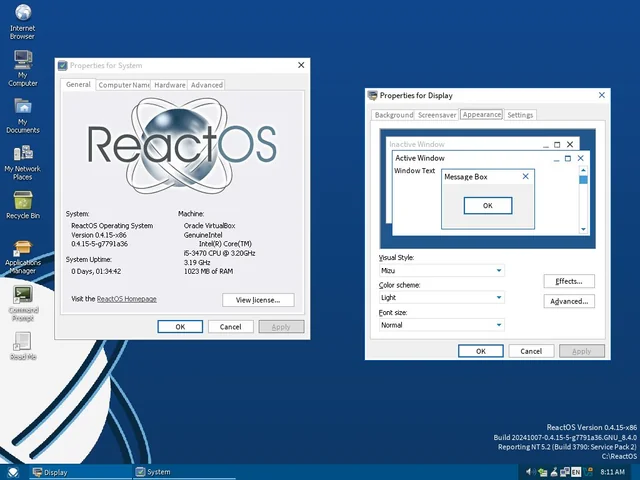
Despite the technical victory of the MSVCRT sync, ReactOS still faces significant hurdles in user adoption. The code might be getting better, but the interaction layer struggles to keep up.
The UX/UI Problem
Development resources in open source are finite. As noted in user commentary, developers prefer solving interesting logic puzzles—like memory management or file system drivers—rather than aligning pixels for a user interface. This leaves ReactOS looking perpetually dated.
While the backend pushes toward ReactOS Windows NT 6.0 compatibility, the frontend often feels stuck in the classic theme era. For the target audience (system administrators, retro enthusiasts, legacy support techs), this is acceptable. For a general user, the lack of a polished, high-DPI aware interface makes the OS feel experimental.
Hardware and Driver Support
The "NT 6" update is meaningless if the OS cannot talk to modern hardware. Windows Vista introduced the WDDM (Windows Display Driver Model), which is complex to implement. While syncing MSVCRT helps applications run, it does not solve the driver issue.
ReactOS currently relies on a mix of older driver models and new attempts at compatibility. Real hardware support is the bottleneck. The operating system runs beautifully in a virtual machine, but installing it on a 2026 laptop remains a gamble. The community recognizes that without solid USB 3.0/4.0 and NVMe support, the OS remains a specialized tool rather than a general-purpose replacement.
Why 2026 is a Turning Point

The timing of this update is significant. We are entering an era where the "PC" concept is shifting. With Windows moving entirely toward cloud-integrated services and subscription models, the definition of a "Personal Computer" is eroding.
Digital Sovereignty
ReactOS represents one of the few attempts to keep the Windows computing paradigm alive as a standalone, owner-controlled concept. By achieving ReactOS Windows NT 6.0 compatibility, the project ensures that the massive library of Windows software remains accessible without the terms and conditions of a modern Microsoft account.
The project has survived 30 years not because it is fast, but because it is necessary. As long as Win32/64 remains the dominant software format, an open-source implementation of that architecture is required for digital history and software freedom.
The Road Ahead
The immediate future for ReactOS involves stabilizing the new MSVCRT integration. Following this, the developers will likely target the next layer of Vista-era dependencies, specifically regarding graphics and networking stacks. The roadmap is clear: complete the transition to NT 6, stabilize the driver model, and offer a haven for the billions of lines of code that Microsoft is slowly leaving behind.
Frequently Asked Questions
What does ReactOS Windows NT 6.0 compatibility mean for users?
It means ReactOS is aiming to support applications and drivers designed for Windows Vista and later versions. This upgrades the system from being primarily XP-compatible to supporting more modern software architectures.
Can ReactOS replace Windows 11 on my daily computer?
Not for general users. ReactOS is currently best used in virtual machines or on specific older hardware for testing and running legacy applications. It lacks the stability and broad hardware support of a modern commercial OS.
Why is the MSVCRT sync with Wine 10.0 important?
MSVCRT is a fundamental library that Windows programs use to function. Syncing with Wine 10.0 brings thousands of bug fixes and improvements, drastically reducing application crashes and improving overall compatibility.
Does ReactOS use Linux code?
ReactOS is not based on the Linux kernel; it writes its own kernel to mimic Windows NT. However, it collaborates with the Wine project to share user-mode code (like DLLs) to save development time.
Is ReactOS safe to use for banking or sensitive data?
It is not recommended for high-security tasks. As an alpha-stage operating system, it may have stability issues or security vulnerabilities that have not yet been patched compared to a production-ready OS.
How does ReactOS handle modern Windows games?
Support is limited. While the new ReactOS Windows NT 6.0 compatibility helps, modern games require advanced DirectX (11/12) and GPU driver support that ReactOS is still developing. Older titles have a much better success rate.
What is the difference between ReactOS and Wine?
Wine is a compatibility layer that lets Windows apps run on Linux or macOS. ReactOS is a standalone operating system designed to be a free, open-source replacement for Windows itself.


