10 TikTok Shop Metrics Every Seller Should Track for Better Profitability

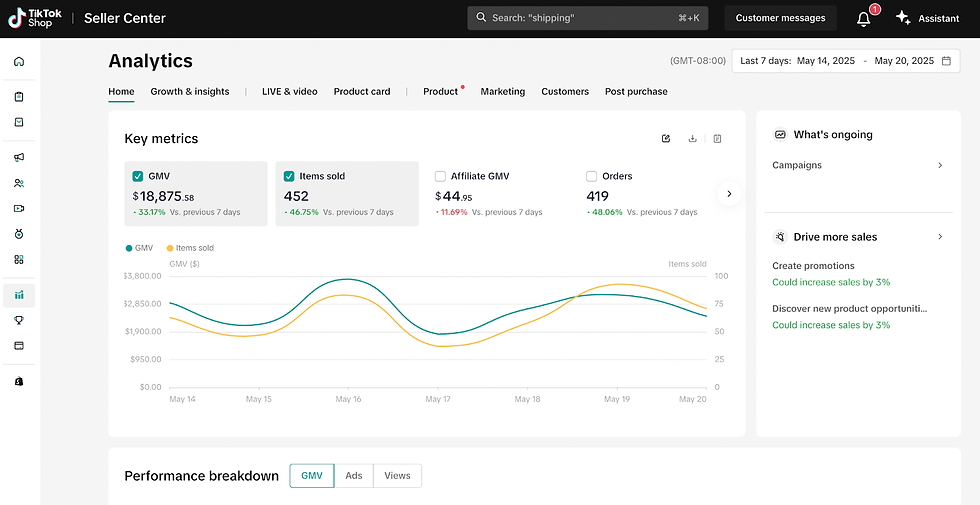
Running a TikTok Shop can look simple from the outside. A product sells, money comes in, and you move on to the next order.
The problem starts when sales increase but the money left at the end of the month does not.
TikTok Shop sellers have to account for product costs, shipping, platform fees, advertising, affiliate commissions, refunds, and other expenses. Looking at revenue alone can make an unprofitable product appear successful.
Tracking the right numbers gives you a clearer picture of what is actually happening in the business.
Here are 10 TikTok Shop metrics worth monitoring regularly.
1. Gross sales
Gross sales show the total value of products sold before accounting for expenses, refunds, or other deductions.
This is one of the first numbers sellers usually look at, but it should not be treated as profit. A shop can generate strong sales while spending heavily on ads, commissions, and fulfillment.
Track gross sales over time and compare them with your costs. If sales are rising but margins are falling, something else in the business needs attention.
2. Number of orders
Orders tell you how many purchases your store is generating. This metric becomes more useful when you compare it with sales. For example, two stores could generate the same revenue while having very different order volumes.
A higher number of orders with a low average order value can create more fulfillment work without necessarily producing better margins. Tracking orders alongside revenue helps you understand how sales volume is changing.
3. Average order value
Average order value, or AOV, tells you how much customers spend per order.
You can calculate it by dividing total sales by the number of orders:
Average order value = Total sales ÷ Number of orders
AOV can help sellers identify opportunities to increase the value of each purchase. Bundles, complementary products, and multi-item offers are some ways sellers may try to increase order value. But higher AOV does not automatically mean higher profit. The additional products still have their own costs.
4. Cost of goods sold
Cost of goods sold, commonly called COGS, is the amount you spend on the products you sell.
If a product sells for $40 and costs $15 to source, the $15 is part of the product's direct cost.
This number is important because a product with strong sales can still have a thin margin if its purchase cost is too high.
Keep your product costs updated, especially when supplier prices change. Using an old COGS figure can make your reported margins look better than they really are.
5. TikTok Shop fees
Selling on TikTok Shop involves more than just the cost of the product itself. Depending on the order type and how a seller's account is set up, TikTok Shop can apply platform fees and other deductions along the way. To get an accurate picture of actual profit, sellers should factor in these costs upfront and using dedicated TikTok Shop tools can make it much easier to track fees, monitor margins, and calculate true take-home earnings from every sale.
Instead of looking only at the product selling price, calculate the amount left after applicable selling fees.
This becomes particularly important when comparing products with different price points and margins.
6. Affiliate commission
Affiliate marketing can be an effective way to get products in front of TikTok audiences, but commissions need to be included in your profitability calculations.
For example, a product may generate $10,000 in sales through creators while paying a significant portion of those sales in affiliate commissions.
That does not necessarily make the strategy unprofitable. The useful question is how much profit remains after those commissions and the other costs associated with the sales.
Track affiliate-driven revenue separately when possible. It gives you a better view of which creator campaigns and products are actually producing profitable sales.
7. Ad spend
Advertising can quickly change the economics of a TikTok Shop product. A campaign might generate thousands of dollars in additional revenue, but revenue alone does not tell you whether the campaign was worth running.
Track how much you spend on ads alongside the sales attributed to those campaigns. Then look at the resulting margin after product costs, fees, commissions, and other expenses.
This also helps you spot products that depend too heavily on paid traffic.
8. Refund and return costs
Refunds and returns can quietly reduce your actual profit. A sale that appears in your revenue figures may later result in a refund, replacement, return shipping cost, or other expense.
Track refund and return activity by product. If one product consistently generates more refunds than others, the issue may be related to product quality, sizing, descriptions, customer expectations, or fulfillment.
The goal is not simply to reduce the refund percentage. It is to understand how refunds affect the money you actually keep.
9. Gross profit
Gross profit gives you a more useful view of product-level performance than revenue alone.
A basic calculation is: Gross profit = Sales − Cost of goods sold − Direct selling costs
The exact calculation can vary depending on which costs you include.
For sellers with several products, comparing gross profit across products can help identify which items generate the most money before broader operating expenses are considered.
A product with lower sales but a stronger margin may deserve just as much attention as a high-volume product.
10. Net profit
Net profit is the number that brings the other metrics together. You can have strong sales, thousands of orders, and successful ad campaigns while still making less money than expected if the costs are not being tracked properly.
A practical way to estimate net profit is:
Net profit = Selling price − COGS − shipping − platform fees − discounts − affiliate commission − ad spend − refund costs − other expenses
Sellers who want to estimate margins before scaling can use a TikTok Shop profit calculator to account for these different costs instead of relying on revenue alone.
For businesses processing a large number of orders, tracking this calculation manually can also become difficult. A profit-tracking tool can bring sales, expenses, commissions, and other numbers into one place so sellers can see the actual result more quickly.
How these metrics work together
No single metric tells the whole story. Imagine a product generates $20,000 in monthly sales. That sounds strong until you account for $7,000 in product costs, $2,000 in advertising, $2,000 in affiliate commissions, $1,500 in fees, and another $1,000 in refunds and other costs.
The important number is what remains after those expenses.
That is why sellers should look at metrics as a group:
Sales show how much revenue the store generates.
Orders show sales volume.
AOV shows the value of each order.
COGS shows product costs.
Fees and commissions show marketplace and creator-related expenses.
Ad spend shows the cost of acquiring sales.
Refunds show revenue lost after purchases.
Gross profit shows product-level profitability.
Net profit shows what remains after the major costs are accounted for.
Looking at these numbers together makes it easier to identify where money is being made and where it is being lost.
Tools that can make tracking easier
Spreadsheets can work for a small store, especially when order volume is low. But as sales increase, manually combining data from different sources becomes harder.
A dedicated analytics or profit-tracking tool can help sellers bring key numbers together and monitor profitability without calculating every order from scratch.
For example, Kixmon is built around TikTok Shop performance tracking. It connects data from Seller Center, Ads Manager, and Affiliate Center so sellers can monitor sales, orders, returns, ad costs, affiliate commissions, and profitability in one dashboard.
The useful part is not simply having more data. It is being able to connect revenue with the costs behind it.
Final thoughts
Growing TikTok Shop sales is only part of running a profitable store. A seller who tracks revenue but ignores product costs, fees, advertising, commissions, and refunds can end up making decisions based on an incomplete picture.
Start with the basics: sales, orders, AOV, COGS, fees, commissions, ad spend, refunds, gross profit, and net profit.
Once those numbers are tracked consistently, it becomes much easier to see which products deserve more attention, which costs need to be controlled, and whether increasing sales is actually increasing profit.


