ChatGPT Ads Are Coming to the US: What Free and Paid Users Need to Know


OpenAI has officially crossed a threshold many users hoped it never would. On January 16, 2026, the company announced that ChatGPT ads will begin appearing for users in the United States. This marks the end of the platform's strictly ad-free era and signals a pivot toward a revenue model that looks increasingly like Google’s.
For years, CEO Sam Altman positioned advertising as a "last resort." That resort has been reached. With infrastructure costs projected to hit the trillion-dollar mark over the next decade, the free tier of ChatGPT is now being monetized to support the massive compute power required to run the models.
If you are using ChatGPT in the US, the experience is changing. Here is what you will see, how the community is reacting, and what this means for your data.
What ChatGPT Ads Look Like and How to Handle Them

Before diving into the business strategy, let’s look at the immediate impact on your screen. The implementation, for now, is designed to be less intrusive than a typical search engine, but it fundamentally alters the user interface.
The Ad Layout: Sidebar vs. Inline
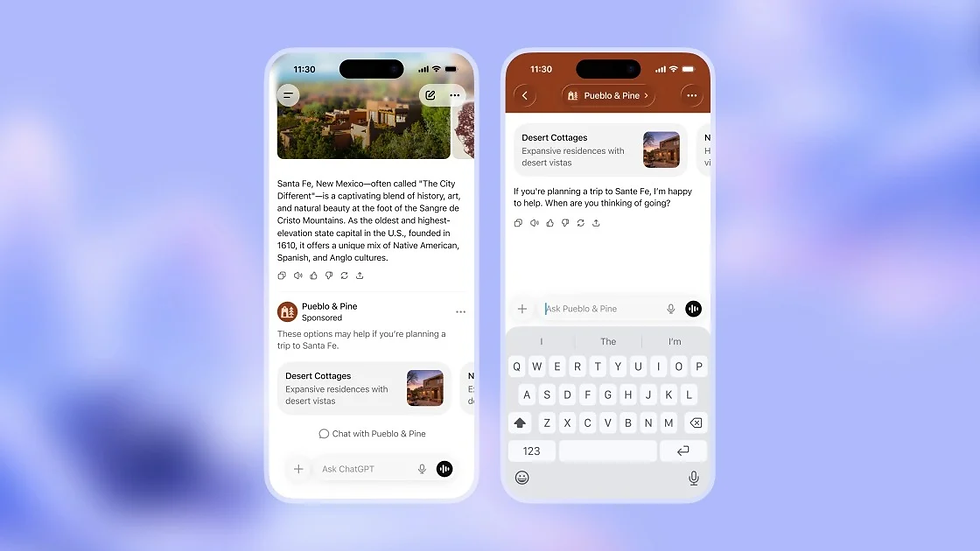
According to OpenAI’s announcement, ChatGPT ads will not break up the text of the answer itself. You won’t see a promotional paragraph interrupting a recipe or a coding script. Instead, ads will appear in the surrounding space—specifically the sidebar, or directly above or below the conversation stream.
These placements are visually distinct. They appear in "colored boxes" or are clearly marked with a "Sponsored" tag. The goal is to keep the AI’s generated response separate from paid content, distinguishing between "answer" and "promotion."
Privacy Controls and Transparency
The ads are contextual. They trigger based on the conversation you are currently having. If you are discussing running shoes, you might see an ad for Nike in the sidebar. To address privacy concerns, OpenAI has added a click-through feature. You can click on an ad unit to see exactly why that specific ad was shown to you.
Can You Remove ChatGPT Ads?
Currently, the only official method to remove ChatGPT ads is a paid subscription. The Pro and Plus tiers remain ad-free environments. This has become the primary differentiator between the services.
For users unwilling to pay, the community discussion on Reddit suggests a migration to other tools. Tech-savvy users are suggesting "local models" (running AI on your own hardware) as the only way to guarantee a permanently ad-free, private experience. Others have stated that if ads bleed into the paid tier, they will cancel immediately. The consensus is clear: the paid product must remain pristine.
The New OpenAI Advertising Strategy

The decision to introduce ChatGPT ads is a direct response to the financial reality of running Generative AI.
Why Now? The Cost of Compute
OpenAI is no longer just a research lab; it is a company facing massive overhead. Reports indicate that OpenAI plans to spend over $1 trillion on infrastructure in the coming years. Subscription revenue alone—while substantial—cannot cover the exponential cost of training new models and serving millions of free users daily.
The OpenAI advertising strategy mirrors the evolution of the early internet. Services start free to build a habit, scale up, and then monetize the user base to subsidize the technology. The company frames this as a necessary trade-off: allowing them to offer advanced intelligence to free users by subsidizing it with corporate sponsorship.
Reversing the "Last Resort" Stance
This move has drawn criticism because it contradicts previous leadership statements. Sam Altman is on record stating he "hates ads" and that they would only be used if absolutely necessary. The arrival of ads in the US market confirms that OpenAI has pivoted from an idealistic product philosophy to a pragmatic "Big Tech" business model.
Strict Exclusions on Content
To protect brand safety and user trust, OpenAI has set guardrails. ChatGPT ads will not appear for:
Users under the age of 18.
Conversations regarding sensitive topics (politics, health conditions, mental health support).
This suggests the ad engine filters context heavily before serving a banner, avoiding the PR nightmare of showing junk food ads next to diet advice or pharmaceutical ads next to medical queries.
User Reactions: Fear of "Enshittification"
The reaction from the core user base has been sharp. On platforms like Reddit, the discussion isn't just about annoyance; it is about trust. The primary fear is the "enshittification" of the platform—a term used to describe how digital services degrade in quality as they prioritize shareholders over users.
The "Soft Ad" and Bias Concerns
The biggest worry isn't the sidebar banner; it's the potential for "hidden" influence. Users are concerned about ChatGPT ads morphing into product placement within the answers.
One Reddit user provided a clear example: If you ask for a root beer recipe, a neutral AI gives you the ingredients. A compromised AI might tell you, "It's hard to make, why not just buy A&W?"
This fear strikes at the heart of the product's value. If users suspect the AI's logic is being swayed by commercial interests, the utility of the tool drops. OpenAI has stated ads are visual and separate, but the community remains skeptical about how long that separation will last.
The Red Line for Subscribers
The ChatGPT Plus community has drawn a hard line. Multiple comments indicate that if ads ever appear in the paid version, the churn rate will be immediate. Subscribers view their monthly fee as a "privacy tax"—payment specifically to avoid being monetized as a product.
Economic Context: Following the Google Playbook

This shift positions OpenAI directly alongside Google and Meta. By introducing an OpenAI advertising strategy, the company is acknowledging that subscriptions have a ceiling. To grow beyond that ceiling, they need the advertising market.
The testing phase in the US is likely just the beginning. If the revenue lift is significant—and if user revolt is manageable—expect this to roll out globally. The defining question for 2026 is not whether AI will have ads, but whether those ads will stay in the sidebar or eventually creep into the code itself.
FAQ: Understanding the Changes to ChatGPT
When will I start seeing ads on ChatGPT?
If you are in the US, the rollout begins in late January 2026. OpenAI confirmed the testing phase will ramp up over the coming weeks, meaning not all users will see them immediately.
Will ChatGPT Plus or Team users see ads?
No. The current announcement applies only to the Free/Go tiers. There is no indication that paid plans will include advertising, and keeping them ad-free is a critical retention strategy.
How does ChatGPT decide which ads to show me?
The system uses the context of your current conversation. It analyzes the topic you are discussing to display relevant ChatGPT ads in the sidebar, rather than tracking your history across the web like traditional cookies.
Can I block ads on ChatGPT without paying?
OpenAI does not offer a free opt-out setting. While browser-based ad blockers might eventually work on the web interface, the only official way to remove ads is to upgrade to a paid subscription.
Are there topics where ads won't appear?
Yes. OpenAI suppresses ads for sensitive subjects such as mental health, politics, and medical advice. Additionally, no ads are displayed to users confirmed to be under 18.


