DeepSeek V4.1 Flash Update Raises the Scores, but the Evidence Stays In-House

Evidence review, October 19, 2026: DeepSeek-V4.1-Flash-1017 is the October 17 update to the September V4.1 Flash model. The figures below are DeepSeek-authored measurements, independently plotted from its model card, not independent reproduction. API prices did not change with this update. Sample sizes, uncertainty intervals and matched cross-provider compute budgets are not disclosed in that comparison table. — Source
DeepSeek released a DeepSeek V4.1 Flash update on October 17, claiming higher benchmark scores, faster task completion, and shorter outputs. The checkpoint, named DeepSeek-V4.1-Flash-1017, replaces the September version across DeepSeek’s web app, mobile app, and API.
The important change is not a new model family or architecture. DeepSeek describes 1017 as a minor update to the existing V4.1 Flash model. Developers still call deepseek-flash, while the service routes requests to the new checkpoint without requiring an API migration.
That quiet replacement creates the central tension. DeepSeek presents a stronger performance-to-cost balance, especially for coding agents and tool-driven work. However, the published results remain company-reported, and several evaluation details needed for close comparisons were not disclosed.
DeepSeek’s numbers still warrant attention. The largest gains appear in terminal work, program synthesis, automation, and tasks spanning entire software repositories. Those are the workloads where Anthropic, OpenAI, Google, Moonshot AI, and Zhipu AI are competing for developer adoption.
The update therefore pressures more than benchmark rankings. It challenges providers to show that premium models finish real tasks more reliably, with fewer tokens and less human intervention. DeepSeek has improved its side of that argument, but outside testing must now determine how much the update changes production outcomes.
The DeepSeek V4.1 Flash Update Is a Checkpoint, Not a New Architecture
DeepSeek has upgraded the model behind an existing product rather than launching another architecture generation.
The company’s October changelog says DeepSeek V4.1 Flash has been upgraded to DeepSeek-V4.1-Flash-1017. The web and mobile applications now use the new version, alongside the API endpoint.
Existing API users do not need a new model identifier. Requests using deepseek-flash reach the latest checkpoint. Legacy identifiers for earlier Flash models also route to the current version, according to DeepSeek’s documentation.
That delivery method can make 1017 look smaller than it is. A stable endpoint reduces migration work, but it also means application behavior can change without a model-name change. Teams evaluating output consistency should record the served checkpoint, not only the API identifier.
The release is distinct from the original V4.1 Flash launch on September 10. That earlier release introduced the model family’s architecture, native visual understanding, longer context support, and revised inference design. The October checkpoint updates the model within that established foundation.
The architecture uses a mixture-of-experts design, or MoE. This approach activates only part of a much larger network for each token, aiming to reduce computation while preserving broad model capacity.
DeepSeek disclosed a 552-billion-parameter backbone for the September model. It said 8 billion parameters are active while processing input and 16 billion are active during output generation. Those specifications describe the V4.1 architecture, not a new parameter configuration introduced with 1017.
The original release also described a causal encoder-decoder design. In simple terms, the model allocates different active capacity to understanding prompts and generating answers. DeepSeek positions that asymmetry as a way to improve throughput and reduce memory demands.
Its technical report describes support for contexts reaching one million tokens. A context window is the amount of material a model can consider within one request. DeepSeek’s current documentation also lists a maximum output allowance of 384,000 tokens.
Those limits did not arrive with 1017. Neither did native vision, which was already part of V4.1 Flash. Treating those capabilities as October additions would overstate what changed.
Instead, 1017 appears to be a post-training and behavior update. DeepSeek says it improves reasoning, coding, agent work, and visual tasks while reducing runtime and response length. The company has not published a separate new parameter count for this checkpoint.
The open model distribution matters as well. DeepSeek released the checkpoint through its model repository under an MIT license. That gives researchers and infrastructure teams access to the weights, subject to the practical demands of serving such a large model.
Open weights make deeper inspection possible. They do not make independent evaluation immediate or inexpensive. Reproducing agent benchmarks requires compatible infrastructure, harness configurations, tool access, retry policies, and substantial compute.
The result is a release that is easy to access through an API but harder to validate comprehensively. That gap explains why DeepSeek’s benchmark table currently carries most of the story.
DeepSeek Coding Benchmarks Show Where the Update Improved
The strongest reported gains concentrate on coding and agent tasks, where shorter runs can matter as much as higher accuracy.
The largest change among these four coding tests is Terminal-Bench 4.0, from 31.2 to 42.3: an increase of 11.1 score points, or about 35.6% relative to the earlier score. DeepSWE v1.1 rises from 74.2 to 77.0. The competitive picture is mixed: the vendor table places Flash-1017 above the model labeled Opus 5 on DeepSWE, but below it on Terminal-Bench, ProgramBench and NL2Repo-Bench. The comparison uses the source’s exact label, Opus 5. Terminal-Bench uses Claude Code, while DeepSWE uses Mini-SWE-V2. The table does not establish equal-budget comparisons or production success rates.

Editorial plot of DeepSeek’s October 17, 2026 model-card data. Higher reported score is better. Terminal-Bench: Claude Code; DeepSWE: Mini-SWE-V2. Evaluation date, sample sizes, reasoning effort, retries and matched token/time budgets are undisclosed in the table. — Source
DeepSeek reports a Terminal-Bench 4.0 score of 42.3 for the 1017 checkpoint. The September V4.1 Flash model scored 31.2 in the company’s comparison. That represents an 11.1-point increase within DeepSeek’s published setup.
Terminal-Bench evaluates agents operating in command-line environments. These tasks require more than writing an isolated function. The model must interpret goals, use tools, navigate files, execute commands, and recover from errors.
The company says it tested Terminal-Bench 4.0 through the Claude Code framework. That detail matters because an agent framework shapes the tools, instructions, and interaction loop available to the underlying model.
On DeepSWE v1.1, DeepSeek reports a rise from 74.2 to 77.0. It used the Mini-SWE-V2 framework for that evaluation. Software engineering benchmarks can be highly sensitive to repository setup, tool permissions, and allowed attempts.
ProgramBench shows a larger numerical jump, from 20.3 to 29.1. NL2Repo-Bench rises from 65.4 to 68.2. The latter focuses on translating natural-language requests into changes across software repositories.
The pattern suggests that DeepSeek targeted sustained coding workflows rather than only short-answer programming. That distinction matters for companies testing agents against issue queues, code review tasks, migrations, and debugging sessions.
Agent benchmarks show a similar direction. DeepSeek reports 60.5 on Automation-Bench v1.0.6, compared with 54.8 for the preceding checkpoint. Agents’ Last Exam rises from 31.8 to 35.4.
Apex Bench v1.1 moves from 64.6 to 72.1 in the company’s table. DeepSeek presents these results as evidence that the update can handle longer sequences involving planning, tool use, and execution.
The visual agent scores also increased. Chartography with tools rose from 78.9 to 83.0, while BabyVision moved from 89.6 to 92.5. ZeroBench-main with tools increased from 49.0 to 51.0.
DeepSeek says ZeroBench-main used Pass@5. That metric allows up to five attempts and records whether at least one succeeds. It should not be read as directly equivalent to a first-attempt success rate.
The company also reports 42.6 on Humanity’s Last Exam without tools. It lists 44.0 for a pure-text subset, although the subset result should not replace the score for the broader evaluation.
The benchmark gains are consistent across every previous-model comparison published in the table. No listed result shows the 1017 checkpoint falling behind the September version. That consistency supports DeepSeek’s claim that the update is broadly better within its chosen evaluations.
However, the table does not disclose sample sizes for several comparisons. It also omits hardware, token budgets, time limits, retry budgets, and reasoning-effort settings. Those variables can materially affect agent evaluations.
A model allowed more tool calls or more reasoning tokens can finish tasks that a stricter configuration misses. It can also consume more time and resources while producing a better score.
DeepSeek says the new checkpoint reduces both runtime and output length. That claim is central because shorter output can lower the amount of generated text an application must process. Faster completion can also improve user experience and agent throughput.
Yet the release materials do not provide one universal percentage for either reduction. Runtime varies with workload, infrastructure, context length, and agent framework. Output length changes with prompts and task complexity.
The responsible reading is therefore narrow. DeepSeek reports better scores, faster completion, and shorter answers across its evaluated harnesses. The exact production improvement remains workload-dependent.
Shorter Outputs Are the Real Competitive Pressure
DeepSeek is arguing that useful AI performance should be measured per completed task, not by raw intelligence scores alone.
DeepSeek reports increases from 54.8 to 60.5 on Automation-Bench v1.0.6, 31.8 to 35.4 on Agents’ Last Exam, and 64.6 to 72.1 on Apex Bench v1.1. Flash-1017 exceeds the table’s Opus 5 result on each of these three tests, although each benchmark measures a different task set. These scores support further evaluation for agent workflows; they do not establish reliable execution in an unrestricted environment. Operators should measure successful task completion, total retries, tool errors, review time and total token cost on their own workloads. DeepSeek recommends Harness 0.2.1-rc.1 or newer for this release.

Editorial plot of three distinct DeepSeek-authored agent benchmarks, release October 17, 2026; higher is better. Exact cross-provider effort and token/time budgets, sample sizes and evaluation date are undisclosed in the comparison table. Do not combine the three results into an overall score. — Source
Model buyers increasingly care about how many successful workflows a system completes within a budget and time limit. A high benchmark score loses value when the model loops, writes unnecessary explanations, or repeatedly calls tools.
Agent tasks magnify this issue. A coding assistant can generate thousands of tokens while exploring the wrong path. It can also waste time rereading files or attempting fixes that fail to address the underlying problem.
DeepSeek’s claim of shorter output directly targets that inefficiency. If 1017 reaches the same or better result with fewer generated tokens, it can reduce latency and operating expense together. That is more consequential than concise prose alone.
The company calls the change a performance-to-cost Pareto improvement. A Pareto improvement means one option becomes better on at least one meaningful dimension without becoming worse on the others being measured.
Here, DeepSeek claims stronger benchmark performance alongside lower runtime and shorter output. The argument is that developers no longer need to trade as much capability for speed or efficiency.
The available evidence supports the performance side within DeepSeek’s evaluation table. It does not fully establish the cost-per-success side because the company has not published detailed task-level resource measurements.
Current model specifications show that Flash-1017 retains the existing service configuration. Both thinking and non-thinking modes remain available, along with tool calls, JSON output, vision, and compatible API formats.
The unchanged endpoint also reduces deployment friction. A team can test the new behavior without rewriting its integration. That advantage can accelerate adoption, especially for developers already using DeepSeek Flash.
It also creates operational risk. Applications built around stable tone, output structure, or refusal behavior can react badly to a silent checkpoint change. Regression testing becomes essential whenever the hosted model changes behind a persistent name.
For coding platforms, the immediate pressure falls on models sold around premium reliability. DeepSeek’s table compares 1017 with K3, GLM-5.3, GPT-5.6 Sol, and a model labeled Opus 5.
Those labels must be reported exactly as DeepSeek provides them. The table does not evaluate every current model from each company. Its Opus 5 label should not be silently converted into another Anthropic release.
DeepSeek’s checkpoint beats the table’s Opus 5 reference on DeepSWE v1.1, Automation-Bench, Agents’ Last Exam, and Apex Bench. It trails that reference on Terminal-Bench, ProgramBench, NL2Repo-Bench, and three listed visual tests.
That mixed result is more informative than a simple winner claim. DeepSeek looks especially competitive on several agent evaluations, but the vendor’s own table does not show it leading every category.
The pressure on rivals comes from the bundle. DeepSeek combines accessible weights, a stable API route, a large context window, multimodal input, and improving agent scores. Each attribute expands the number of teams willing to test it.
The September release already framed efficiency as an architectural goal. DeepSeek said V4.1 Flash used one-quarter of the high-bandwidth memory and one-eighth of the solid-state storage for its key-value cache.
A key-value cache stores information generated during inference so the model does not recompute everything for each new token. Smaller caches can reduce the memory burden of long prompts and repeated agent interactions.
Those architectural claims belong to V4.1 Flash as a family. The October story is that DeepSeek says post-training made the existing design more effective. It did not announce another cache redesign with 1017.
This distinction matters for buyers. Architecture explains why a model might be economical to serve. Checkpoint behavior determines whether it completes the buyer’s actual tasks accurately and efficiently.
Teams evaluating the update should therefore measure completed work, not only generated tokens. They should track successful changes, accepted outputs, human corrections, elapsed time, and retries across representative workflows.
That evaluation can fit into broader AI workflows. The essential step is preserving prompts, source material, outputs, and review decisions for later comparison.
What the Benchmark Table Does Not Establish
DeepSeek’s numbers are meaningful evidence of its engineering direction, but they are not independent confirmation of production reliability.
The visual-tool results improve but do not show an across-the-board lead. Chartography moves from 78.9 to 83.0, BabyVision from 89.6 to 92.5, and ZeroBench-main from 49.0 to 51.0. The source’s Opus 5 scores remain higher at 84.0, 94.1 and 52.0. These are tool-enabled evaluations, so the numbers cannot be read as raw image-only accuracy. ZeroBench-main uses Pass@5, which permits multiple attempts; its result should not be presented as first-attempt reliability. Visual agents still need appropriate tool permissions, error recovery and human review for consequential actions.

DeepSeek-authored, tool-enabled visual evaluations, release October 17, 2026; higher is better. ZeroBench-main is Pass@5. Other retry limits, sample sizes, uncertainty intervals, matched budgets and evaluation date are undisclosed in the table. — Source
The main limitation is source independence. DeepSeek published the comparison and selected the models, benchmarks, harnesses and configurations. The primary sources reviewed for this article do not provide an independently reproduced result for the exact 1017 checkpoint.
That does not make the scores false. Vendor evaluations are often the first evidence available after a model release. They can show where a company invested and which workloads it expects to improve.
They cannot settle every comparison. Agent benchmarks contain more moving parts than standard question-and-answer tests. A framework’s system prompt, tools, timeout, sandbox, and retry logic can change the final score.
DeepSeek discloses some conditions. Terminal-Bench used Claude Code, DeepSWE used Mini-SWE-V2, and ZeroBench-main used Pass@5. The company also recommends DeepSeek Harness version 0.2.1-rc.1 or later.
That recommendation suggests harness integration forms part of the performance story. DeepSeek says it optimized the model for its own harness, Tencent CodeBuddy, WorkBuddy, and other platforms.
Model and harness improvements are both legitimate. However, buyers need to know whether gains travel across environments. A checkpoint tuned around one agent loop might perform differently inside another company’s orchestration layer.
The absence of disclosed reasoning settings adds uncertainty. DeepSeek supports multiple thinking-effort levels, which affect how much internal computation a request receives. A higher setting can improve outcomes while increasing latency or token use.
Hardware details matter for speed claims as well. Runtime on a hosted service does not translate directly to self-hosted inference. Network overhead, batching, quantization, and accelerator choice can dominate observed latency.
The open weights make those questions testable, but self-hosting is not automatically simple. A 552-billion-parameter backbone creates demanding storage and memory requirements, even when only part of the network activates per token.
Quantization reduces memory by storing weights at lower numerical precision. It can make deployment more practical, but results may differ from the official checkpoint configuration. Teams should validate accuracy after any conversion.
Security presents another production concern. Coding agents often read repositories, execute commands, install packages, and modify files. A better benchmark score does not establish that a model can safely receive broad permissions.
Organizations should isolate agent work, restrict credentials, log tool calls, and require review for sensitive changes. These controls apply to every coding model, regardless of benchmark position.
The same caution applies to the one-million-token context window. Supporting a large context does not guarantee reliable retrieval from every position. Long prompts can introduce distraction, conflicting instructions, and unnecessary processing.
DeepSeek’s native vision support also predates the October update. The higher visual agent scores suggest improved use of that capability, but they do not prove equal reliability across charts, interfaces, documents, and natural images.
Historical context reinforces the need for measured claims. DeepSeek’s V4 launch drew attention because it combined large context support with an efficiency-focused architecture. Independent analysts quoted in earlier coverage viewed the family as competitive with leading American models.
That broader competitiveness does not automatically validate the new checkpoint’s exact improvements. The 1017 weights require their own tests, especially on workloads that resemble real deployments.
A practical evaluation should compare both checkpoints with identical prompts and tools. It should preserve temperature, effort settings, timeouts, retry counts, and repository states.
Reviewers should also score output quality after removing verbosity advantages. A shorter answer is useful when it stays complete. It becomes a regression if it omits tests, caveats, migration steps, or failure explanations.
For knowledge work, concision can produce similar tradeoffs. Short summaries reduce reading time, but compressed answers can conceal uncertainty or discard minority evidence. Human review remains necessary for consequential decisions.
The right skepticism is therefore specific. DeepSeek has published credible first-party evidence of improvement. It has not yet established universal speed gains, lower total task cost, or superior reliability across independent production environments.
Three Signals Will Show Whether Flash-1017 Changes the Market
Independent reproduction, cross-harness performance, and sustained developer adoption will determine whether 1017 becomes more than a strong vendor benchmark release.
The October 17 update replaces the checkpoint served by the deepseek-flash API alias, with prices unchanged. As checked on October 19, one million Flash tokens cost $0.003 cached input, $0.15 uncached input and $0.60 output off-peak; peak rates are $0.006, $0.30 and $1.20. For an explicitly hypothetical task using one million uncached input tokens, four million cached input tokens and 100,000 output tokens, the model-token charge is $0.222 off-peak or $0.444 peak. This arithmetic excludes search/fetch charges, infrastructure, retries and human review. Shorter output can reduce the output charge, but DeepSeek’s speed-and-cost claim is not a fixed saving for every workload.
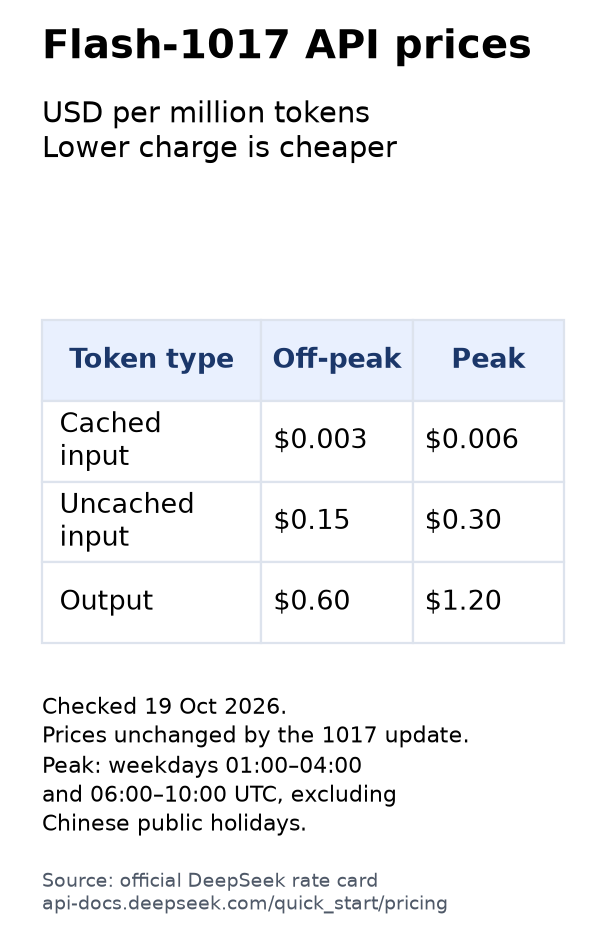
Official Flash-1017 rate card checked October 19, 2026, USD per million tokens; lower charge is cheaper. Peak hours are weekdays 01:00–04:00 and 06:00–10:00 UTC, excluding Chinese public holidays. Model-token prices are separate from search/fetch and other operating costs. — Source
The first signal is independent evaluation of the exact 1017 checkpoint. Researchers need to test the released weights rather than the September model or a hosted alias with an uncertain version.
Those tests should publish prompts, harness versions, effort settings, hardware, time limits, and retry policies. Results should include accuracy, elapsed time, output tokens, and failed-task behavior.
Matching DeepSeek’s reported direction would strengthen the company’s case. Large regressions or highly configuration-dependent gains would weaken it. Mixed results would suggest that 1017 benefits some agent loops more than others.
The second signal is performance across multiple harnesses. DeepSeek specifically optimized for selected platforms, making portability a central question. The model should retain its gains in alternative coding agents and enterprise orchestration systems.
Cross-harness testing can separate model improvement from integration improvement. Both have value, but they answer different purchasing questions.
A company adopting DeepSeek Harness can benefit from the combined system. A company keeping an established internal agent needs evidence that the checkpoint alone improves its workflow.
Watch whether third-party tests reproduce the Terminal-Bench increase without modifying tool access. Also watch whether shorter outputs remain complete when another framework uses a different system prompt.
Consistent gains would support DeepSeek’s claim of a better underlying checkpoint. Gains limited to preferred harnesses would make integration choice a larger part of the decision.
The third signal is sustained developer adoption after the initial release cycle. Downloads, integrations, reproducible tests, and production case studies matter more than launch-week attention.
The MIT-licensed weights lower legal friction for experimentation. However, the model’s scale raises the infrastructure threshold for serious self-hosting. Many teams will still choose hosted access or specialized inference providers.
Adoption should therefore be measured across both routes. Hosted usage shows whether the API experience is attractive. Self-hosted deployments show whether open access creates practical alternatives for organizations with specialized requirements.
Retention matters more than trials. Developers frequently test new models because switching an API identifier is easy. They keep a model only when it improves accepted work without creating new review burdens.
The likely near-term outcome is broader testing, not an immediate market reshuffle. DeepSeek has given coding-agent teams a concrete reason to rerun their evaluations. Its strongest reported gains align with tasks that developers already struggle to automate reliably.
Competitors still have room to respond through better models, stronger agent frameworks, lower latency, safer execution, or more predictable behavior. DeepSeek’s own table shows that the 1017 checkpoint does not lead every comparison.
The release also demonstrates a faster competitive cadence. A major architecture arrived in September, followed by a behavior-focused checkpoint five weeks later. Stable API routing lets DeepSeek distribute that improvement immediately.
That cadence benefits users when updates produce measurable gains. It complicates governance when behavior changes faster than enterprise evaluation cycles. Teams need version records and recurring regression suites to manage both effects.
For developers, the decision is straightforward. Test DeepSeek-V4.1-Flash-1017 against the exact tasks your users perform. Measure accepted outcomes, retries, latency, output length, and human corrections.
Enterprise buyers should ask providers for checkpoint identifiers and change notices. They should also require reproducible evaluation conditions before treating any benchmark lead as a purchasing conclusion.
Knowledge workers should pay attention to whether shorter responses preserve evidence and nuance. A faster answer creates little value when someone must reconstruct missing reasoning afterward.
The DeepSeek V4.1 Flash update has already changed the comparison set. It raises the previous checkpoint’s coding and agent scores while keeping the same access path and model family.
What happens next depends on evidence outside DeepSeek’s laboratory. Run controlled comparisons, preserve the full evaluation record, and watch whether independent tests reproduce the claimed combination of accuracy, speed, and concision.


