New SAFE Exit Act Mandates Manual Door Handles After Tesla Safety Concerns


The digitization of the automobile has removed buttons, knobs, and now, even door handles. While aesthetically sleek, the shift toward fully electronic door latches has introduced a critical safety vulnerability. In response to mounting concerns and investigations, U.S. lawmakers have introduced the SAFE Exit Act, a bill designed to force manufacturers to reinstall functional, intuitive manual door handles. This isn't just about convenience; it is a response to documented cases where occupants were trapped inside burning or powered-down electric vehicles because they couldn't find the emergency release.
User Experience and the Need for the SAFE Exit Act

Before diving into the legislation, we need to look at the user experience that necessitated it. The primary driver for this bill is the confusion and panic occupants face when an electronic system fails.
If you drive a standard combustion vehicle and the battery dies, you simply pull the lever. The mechanical linkage unlatches the door. In many modern EVs, specifically designs popularized by Tesla, the interior "handle" is actually an electronic switch. When you press the button, an actuator pops the door open. If the vehicle loses power—a common occurrence during severe collisions where the pyro fuse blows to protect the high-voltage battery—that button does nothing.
The Model Y and Model 3 Discrepancy
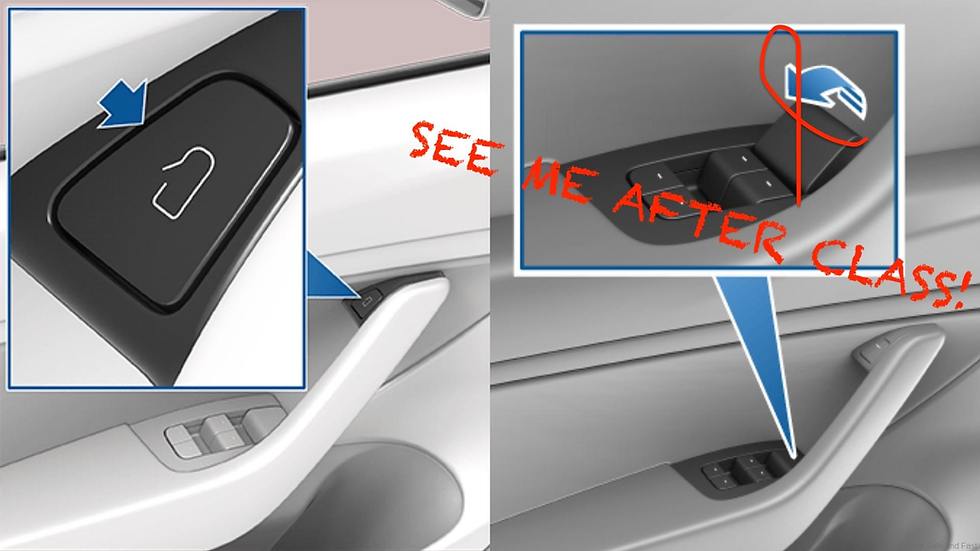
Current Tesla owners often discuss the inconsistency in emergency designs on forums and Reddit. In a Model 3 or Model Y, the front doors have a manual release lever located just forward of the window switches. It is relatively visible, though some passengers mistake it for a window control.
The rear doors are a different story. In the Model Y, the manual release is hidden at the bottom of the door pocket, underneath a rubber mat. To use it, a passenger must:
Remove the storage mat.
Find a small plastic tab.
Pull it to release the cable.
In a smoke-filled cabin or a panic situation, expecting a rear-seat passenger (often a child) to perform this sequence is unrealistic. This specific design choice is a core target of the SAFE Exit Act. The legislation argues that safety features cannot be hidden or require "special knowledge" to operate.
The Cybertruck Complexity
The situation becomes more complex with the Cybertruck. This vehicle lacks physical door handles on the exterior entirely, relying on buttons on the B and C pillars. Internally, it relies on an electronic unlatch button. Since the truck utilizes a 48V architecture and steer-by-wire system, a total power loss renders the vehicle significantly harder to exit than a standard car.
Users have pointed out that while these vehicles have mechanical backups, they are often described in the manual as "for emergency use only" and can be difficult to engage if the trim is warped due to crash damage.
How the SAFE Exit Act Addresses Electronic Latch Failures
The SAFE Exit Act, introduced by Representative Robin Kelly, stands for "Securing Accessible Functional Emergency Exit Act." It does not ban electronic locks, but it mandates a specific layer of redundancy that many manufacturers have started to strip away.
The bill outlines three main requirements for any vehicle with electronic door systems:
Accessibility: The manual override must be easy to reach for all passengers, including those in the rear seats.
Intuitive Design: The function of the handle must be obvious. It cannot be a hidden pull-cord or a lever buried under trim. It needs to look and act like a door handle.
Labeling: If the operation isn't immediately clear, it must be clearly labeled.
Why Legislation Was Required
Automakers rarely reverse cost-saving or aesthetic trends without external pressure. Electronic latches allow for smoother aerodynamic profiles and cheaper assembly processes (fewer moving rods and clips inside the door panel). However, the National Highway Traffic Safety Administration (NHTSA) has launched investigations into these designs, citing reports where doors failed to unlock during emergencies.
Bloomberg reports highlighted at least 15 fatalities across 12 incidents involving Tesla vehicles where the inability to exit the vehicle was a contributing factor. While Tesla has updated its software to unlock doors automatically upon airbag deployment and flash hazards, software cannot overcome a physical severing of the low-voltage power lines. The SAFE Exit Act aims to codify a hardware solution that software cannot glitch out of.
Technical Vulnerabilities: Electronics vs. Mechanics

The debate surrounding the SAFE Exit Act often centers on the definition of "innovation." Proponents of the bill argue that removing a mechanical link isn't innovation; it's a failure of safety engineering.
The Failure Point
In a crash, the 12V (or 48V) battery system is the lifeline for door operations. If the collision damages the low-voltage battery or cuts the wiring loom leading to the door controllers, the door remains latched.
Safety advocates note that mechanical locks can also jam if the frame is bent—a point raised by Reddit users sharing experiences with older trucks like the Nissan Hardbody. However, a mechanical jam is a result of structural deformation. An electronic failure can happen even if the door structure is perfectly intact, simply because the wire was cut. The electronic system introduces a point of failure that exists before the crash forces even reach the door frame.
Standardization Issues
Currently, there is no standard for emergency exits in EVs.
Corvette C6: Uses floor-mounted levers.
BYD: Uses pop-out handles that require power to present themselves.
Tesla: Uses a mix of visible levers and hidden cables.
This lack of standardization creates cognitive load. If you get into an Uber or a friend's car, you shouldn't need a briefing on how to get out. The SAFE Exit Act pushes for a return to a universal design language where "pulling a handle" equals "opening the door," regardless of the powertrain status.
Industry Implications and Future Design

If passed, the SAFE Exit Act will force a redesign of interior door panels for several major manufacturers, not just Tesla.
We are already seeing global shifts in this direction. Chinese regulators have recently proposed similar safety standards requiring accessible mechanical releases, signaling that the "hidden handle" trend may be ending globally.
For manufacturers, this means re-engineering door cards to accommodate physical cables that connect directly to the latch mechanism. It challenges the minimalist interior aesthetic that dominates the EV market. We may see a return to "double-pull" systems—where the first pull unlocks electronically, and a continued, harder pull engages the mechanical cable. This satisfies the desire for electronic ease-of-use while remaining compliant with the SAFE Exit Act.
The resistance to this bill often comes from the perspective that it stifles innovation. However, the counter-argument is that valid innovation improves function. Replacing a 100% reliable lever with a button that requires a backup manual reading to operate in an emergency is a regression in usability.
The Verdict on Hidden Latches
The era of the hidden latch is likely closing. Whether through the SAFE Exit Act or updated NHTSA crash ratings, the liability associated with trapping passengers is becoming too high for automakers to ignore. For the consumer, this marks a return to physical control over their own safety—ensuring that getting out of a car doesn't require checking the owner's manual during a fire.
Frequently Asked Questions
What specifically does the SAFE Exit Act require from car makers?
The Act requires that all passenger vehicles with electronic door locks have a manual override that is clearly labeled, easy to locate, and intuitive to use. It specifically targets designs where emergency releases are hidden under mats or behind trim panels.
Does the SAFE Exit Act only apply to Tesla vehicles?
No, the legislation applies to all vehicle manufacturers selling cars in the United States. While Tesla is frequently cited due to its high market share and specific design choices (like the Model Y rear door), brands like Chevrolet (Corvette) and various luxury EVs with electronic latches will also need to comply.
Why are electronic door handles considered dangerous?
Electronic handles rely on a low-voltage power supply to unlatch the door. In a severe accident, power can be cut due to battery damage or safety fuse activation, rendering the interior buttons useless. Without a mechanical backup, occupants can be trapped inside.
Do current Teslas have mechanical door releases?
Yes, but with caveats. Model 3 and Model Y front doors have visible mechanical levers. However, Model Y rear door mechanical releases are hidden underneath the door pocket mats and are difficult to access. The Model 3 rear release is also not immediately obvious to untrained passengers.
Can rescue workers open electronic doors from the outside?
It is often difficult. If the door handles are flush and electronic (like on a Cybertruck or Model S) and power is lost, there is nothing for rescuers to grab. They often have to break the glass, which can be challenging with laminated "acoustic" or armored glass used in modern EVs.
What is the difference between the SAFE Exit Act and existing NHTSA rules?
Existing NHTSA standards focus on door retention (keeping doors closed during a crash). The SAFE Exit Act focuses on egress (getting out after the crash). It fills a regulatory gap created by the introduction of fully electronic latching systems.

