OpenAI Prism Launches Free LaTeX Workspace with GPT-5.2 for Scientists


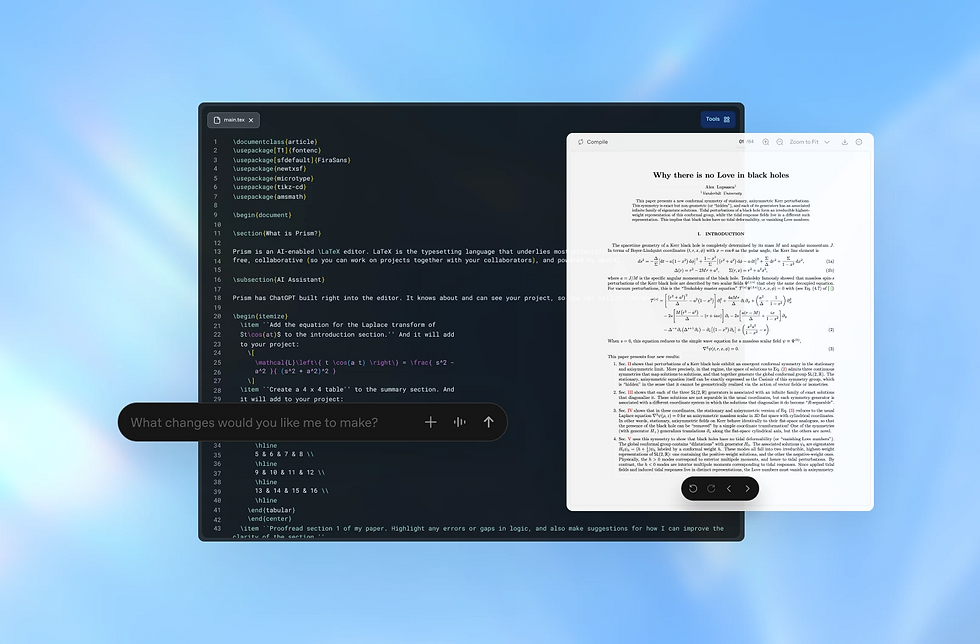
The barrier to entry for scientific publishing just dropped significantly. OpenAI has officially released OpenAI Prism, a specialized workspace designed to handle the heavy lifting of academic writing. Built directly on top of GPT-5.2, this tool isn't just another chatbot wrapper; it’s a full-fledged environment that integrates reference management, mathematical typesetting, and collaborative editing.
For years, researchers have juggled a fragmented workflow involving Overleaf for compiling, separate reference managers, and isolated chat windows for AI assistance. OpenAI Prism attempts to unify this by offering a context-aware platform where the AI understands the entire manuscript structure—citations, equations, and logic—rather than just isolated text fragments.
How OpenAI Prism Changes the Scientific Workflow

The most immediate impact of OpenAI Prism lies in its ability to remove the friction from technical typesetting. Anyone who has written a paper for NeurIPS or similar conferences knows the pain of debugging LaTeX errors or formatting bibliography files.
Fixing the "Blank Page" Problem
User experience reports suggest that OpenAI Prism functions less like a standard editor and more like an "academic implementation of Cursor." The tool automates the tedious aspects of formatting. Instead of manually coding a complex matrix or searching for the correct syntax for a specific symbol, users can instruct the system in natural language.
A standout feature is the multi-modal ingestion. Researchers often start with messy whiteboard scribbles or handwritten notes. OpenAI Prism allows you to upload a photo of a diagram or an equation, and it converts that visual input into clean, compiling LaTeX code. This bridge between the physical brainstorming phase and the digital drafting phase addresses a specific bottleneck in the research lifecycle.
Context-Aware Editing
Unlike pasting a paragraph into a generic ChatGPT window, OpenAI Prism has visibility into the entire project. If you ask it to "make the methodology section more concise," it does so while maintaining consistency with the abstract and conclusion. It handles reference insertion by connecting to external databases like arXiv, pulling in the correct BibTeX entries automatically. This "context awareness" is the defining feature of the GPT-5.2 integration, moving beyond simple text generation to structural document management.
The OpenAI Prism Tech Stack: GPT-5.2 and Crixet

Integrating Acquired Technology
Understanding the capability of OpenAI Prism requires looking at its foundation. The platform is built on the architecture of "Crixet," a cloud-based LaTeX platform acquired by OpenAI. This explains why the product feels mature at launch regarding rendering and compilation—it isn't a new engine, but a supercharged version of an existing one.
Utilizing GPT-5.2 Features
The engine driving the logic is GPT-5.2. In the context of scientific writing, this model upgrade provides sharper reasoning capabilities and a reduced hallucination rate, which is critical when dealing with experimental data and citations. The system is designed for high-precision tasks. It doesn't just "guess" the next word; it predicts the logical flow of a scientific argument.
Currently, the tool allows for unlimited projects and collaborators without seat limits, a strategic move to capture the market share of research labs and university departments quickly.
OpenAI Prism vs Overleaf: The Battle for Academic Editors
The inevitable comparison is with Overleaf, the current industry standard for cloud-based LaTeX editing. Early feedback from the academic community describes OpenAI Prism as a potential "Overleaf Killer," though with distinct caveats regarding ecosystem maturity.
Automation vs. Stability
Overleaf wins on stability and an entrenched ecosystem of templates and institutional integrations. OpenAI Prism wins on speed. The automation features mean that non-native English speakers, in particular, can focus entirely on the science rather than the phrasing. The tool handles the linguistic heavy lifting, essentially leveling the playing field for international researchers.
The "Feature Island" Problem
However, experienced users have pointed out significant gaps. OpenAI Prism currently lacks robust version control features like Git integration. For serious developers and computer scientists who treat their papers like software repositories, this is a dealbreaker. Users accustomed to the granular control of local environments or the version history transparency of Overleaf may find OpenAI Prism too "black box" in its current state. It operates somewhat as a functional silo—great for writing, but currently disconnected from broader codebases or external versioning systems.
The Data Privacy Elephant in the Room
While the features are compelling, the conversation around OpenAI Prism is dominated by privacy concerns. Scientific research relies on the confidentiality of data prior to publication.
Academic Data Privacy Concerns
A major sentiment extracted from user discussions is hesitation. Researchers are wary of uploading unpublished breakthroughs to an OpenAI server. The fear is dual-pronged: IP leakage and model training. Users are asking if their novel chemical structures or proprietary algorithms will be ingested to train the next version of GPT.
Opt-Out and Ownership
OpenAI has standard terms that allow for "opt-out" mechanisms regarding training data, and legally, users retain ownership of both input and output. However, the optics remain tricky. Critics argue that unless there is a guaranteed, auditable "air gap" between the workspace and the training cluster, institutional adoption may be slow. Some users explicitly mentioned sticking to local tools or alternatives like "Bibby AI," which they perceive as having clearer boundaries regarding data security.
For OpenAI Prism to succeed at the enterprise/university level, these privacy guarantees will likely need to be highlighted more aggressively than they are in the current launch materials.
Future Trends: OpenAI for Science
The release of OpenAI Prism aligns with a massive surge in scientific output. Submissions to conferences like NeurIPS skyrocketed from roughly 9,500 in 2020 to over 21,500 in 2025. The volume of research is outpacing the human capacity to format and review it.
Tools like Prism are not just conveniences; they are becoming necessities to keep up with the velocity of modern science. By reducing the friction of formatting and basic drafting, researchers can theoretically spend more time on experimentation and less on fighting with compile errors.
The roadmap indicates that OpenAI Prism will soon roll out to ChatGPT Team and Enterprise plans, suggesting a move toward deeper institutional integration. If OpenAI can patch the missing features—specifically Git support and stricter privacy controls—the shift from Overleaf to Prism could happen faster than the academic world expects.
FAQ: OpenAI Prism

Is OpenAI Prism free to use for individual researchers?
Yes, OpenAI Prism is currently free for users with a standard ChatGPT login. There are no seat limits for collaborators, meaning you can invite co-authors without them needing a paid subscription.
How does OpenAI Prism handle reference management?
The tool has built-in search capabilities that connect to repositories like arXiv. It can automatically find, cite, and format references into your bibliography file, reducing the need for external reference managers.
Can I use OpenAI Prism if I don't know LaTeX?
Yes, that is a primary use case. You can write in plain English or paste content, and the GPT-5.2 engine converts it into proper LaTeX code, handling the syntax and formatting for you.
Does OpenAI Prism support version control like Git?
At launch, the tool does not have native Git integration. This is a frequently requested feature by users who currently rely on Overleaf or local editors for version tracking.
Will my research paper be used to train OpenAI models?
By default, OpenAI policies may allow data usage, but the platform provides an opt-out mechanism for users who do not want their data used for training. Users retain full ownership of their intellectual property.
What is the difference between OpenAI Prism and Crixet?
Crixet was a cloud-based LaTeX platform acquired by OpenAI. Prism is the evolution of that technology, now integrated with GPT-5.2 to add generative and corrective AI capabilities to the underlying Crixet editor.


