The Clair Obscur: Expedition 33 Gen AI Disqualification: A Deep Dive into the Controversy


The independent gaming sector faced a significant upheaval in December 2025. Just days after the Indie Game Awards (IGA) ceremony, the organization announced the Gen AI disqualification of its biggest winner, Clair Obscur: Expedition 33. Originally crowned Game of the Year and Best Debut Game, the title was stripped of its accolades following revelations that Sandfall Interactive utilized generative artificial intelligence during development.
This incident is not just about one studio losing a trophy. It exposes the widening fracture between purist artistic standards and the technical realities of modern game development. The Clair Obscur: Expedition 33 situation forces the industry to confront hard questions about disclosure, the definition of "indie," and where exactly we draw the line on automation.
Navigating the Gen AI Disqualification Minefield: Developer Experiences

Before dissecting the specific rules that led to the Clair Obscur: Expedition 33 Gen AI disqualification, we need to look at the practical reality developers face today. The gap between rulebooks and coding environments is where most studios, including Sandfall Interactive, find themselves in trouble.
The "Placeholder" Trap
Based on industry discussions and the specifics of this case, the most dangerous area for developers is the use of temporary assets. Sandfall Interactive admitted to using AI for "placeholder textures" that were allegedly replaced before the final build.
For many creators, this feels like standard efficiency. You generate a texture to test lighting, intending to have an artist paint over it later. However, when a competition or platform has a "Zero AI" policy, the process matters as much as the product. The IGA's decision to enforce the Gen AI disqualification highlights that usage at any stage—even for assets that don't make the shipping disc—can violate strict entry terms if the rules prohibit AI "in development."
The Invisibility of Modern AI Tools
Developers discussing the Clair Obscur: Expedition 33 situation note that avoiding AI entirely is becoming technically nearly impossible. It creates a paradox for entrants:
Integrated IDEs: Modern coding environments (like Visual Studio with Copilot) often have AI enabled by default. A programmer might tab-complete a boilerplate function without thinking of it as "Generative AI."
Asset Store Risks: Small teams buying packs from the Unity or Unreal stores often inadvertently acquire AI-generated content. If a third-party vendor didn't label their tree texture as AI-generated, the indie developer takes the fall.
Translation and Upscaling: Is Google Translate Gen AI? Is DLSS (Deep Learning Super Sampling)? Technically, yes. They use transformer models and deep learning.
Actionable Insight for Developers: To avoid a similar Gen AI disqualification, strict internal audits are necessary. Don't just check your final assets. Check your commit history for placeholder files and disable auto-complete coding assistants if the submission guidelines demand a "human-only" creation process. Transparency during the submission phase—rather than after the award—is the only safety net.
Clair Obscur: Expedition 33 and the Timeline of Events
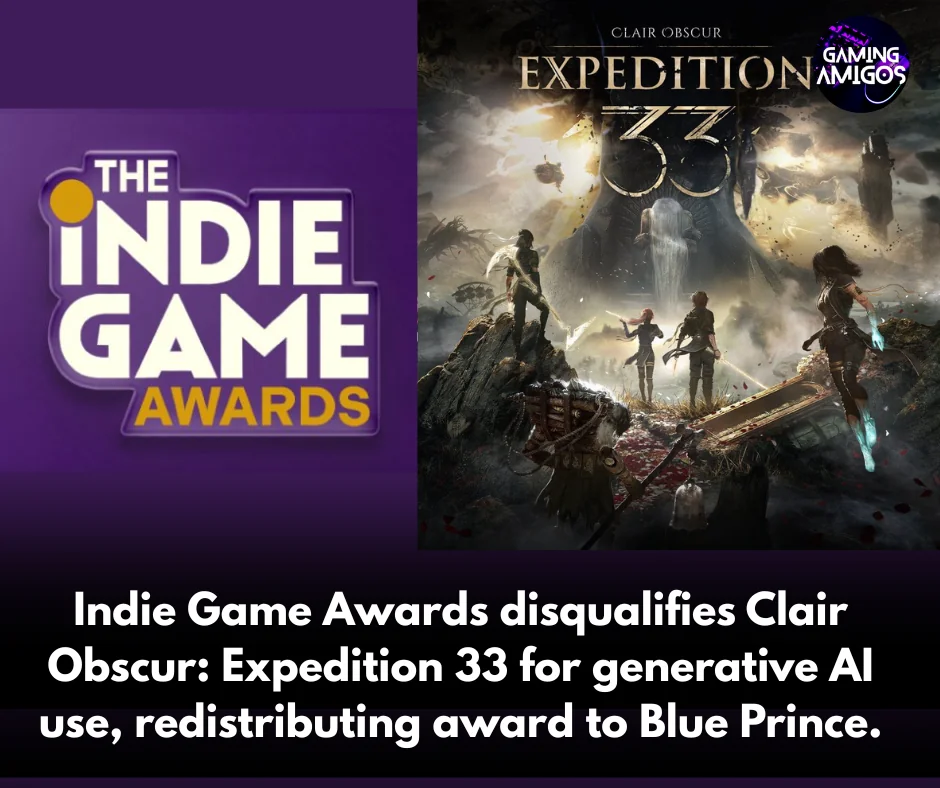
The specific sequence of events provides context for the severity of the IGA's response. The Clair Obscur: Expedition 33 Gen AI disqualification wasn't immediate. The awards were handed out on December 18. The retraction came two days later, on December 20.
The core issue wasn't just the technology; it was the perceived breach of trust. Sandfall Interactive had initially checked the "No AI" box during the submission process. The IGA has taken a hardline stance against generative tech to protect human artistry. When it came to light—allegedly confirmed on the day of the premiere—that Gen AI had played a role in the pipeline, the organization viewed the initial submission as dishonest.
As a result, Blue Prince inherited the Game of the Year title, and Sorry We're Closed took home Best Debut. The swiftness of the decision signals that award bodies are no longer treating AI policies as guidelines, but as rigid eligibility criteria.
Analyzing the Gen AI Disqualification Policy vs. Industry Standards
The Clair Obscur: Expedition 33 incident illustrates a clash between restrictive competition rules and broader industry adoption.
The IGA's "Hard Line"
The Indie Game Awards positioned themselves as defenders of human-created art. Their criteria regarding Clair Obscur: Expedition 33 implies a definition of "development" that includes the entire pipeline. If AI touched the project, even if it was scrubbed later, it seemingly disqualified the entry. This mirrors the anxieties of artists who fear that normalizing AI anywhere in the pipeline eventually devalues human labor everywhere.
The Steam Reality
Contrast this with Valve's Steam policy. Steam requires disclosure but permits the technology. They categorize usage into "Pre-Generated" (assets created beforehand) and "Live-Generated" (AI running while the game plays).
Steam’s data suggests that over half of the developers participating in events like Next Fest use AI in some capacity. By enforcing a Gen AI disqualification on a high-profile game like Clair Obscur: Expedition 33, the IGA is essentially stating that "Industry Standard" does not equal "Award Worthy." This creates a fragmented ecosystem where a game can be commercially viable and compliant on storefronts but ineligible for cultural recognition.
The Identity Crisis: What Is an "Indie" Game?
While the headlines focus on the Gen AI disqualification, the discourse surrounding Clair Obscur: Expedition 33 also revived the debate over what constitutes an "indie" title.
Budget and Scope
Clair Obscur: Expedition 33 is not a "bedroom programmer" project. With a budget estimated north of $10 million and backing from Kepler Interactive, it operates on a different tier than the typical pixel-art platformer.
The controversy here is twofold. First, high-budget productions squeezing out smaller creators. Second, the expectation of resources. A team with millions of dollars has the budget to hire human artists for every single texture. Critics argue that Sandfall Interactive using AI wasn't a survival necessity—as it might be for a solo dev—but a cost-cutting measure.
This nuance impacts how the public views the Gen AI disqualification. There is less sympathy for a well-funded studio cutting corners with AI than there would be for a solo developer using AI to fill gaps they couldn't afford to outsource.
Technical Definitions: Where Does AI Stop?
The Clair Obscur: Expedition 33 fallout has pushed technical experts to demand better definitions. "Gen AI" is a marketing term, not a strict technical boundary.
If the IGA disqualifies Clair Obscur: Expedition 33 for AI usage, observers are asking where the line is drawn for future nominees.
Machine Learning vs. Generative AI: Many physics engines and animation smoothing tools use machine learning. These are "tools," not "creators." However, as features like Photoshop's "Content-Aware Fill" evolve into "Generative Fill," the line blurs.
The Code Question: As noted in the developer experiences section, modern coding is arguably 60-70% debugging and 30% writing. If an AI writes the boilerplate code and a human debugs it, who wrote the game?
Localization: Does using a Transformer model to translate localized text count as a Gen AI disqualification event? Strict interpretations suggest it does.
Without a technical whitepaper defining these boundaries, future disqualifications will feel arbitrary.
The Future of Awards and Clair Obscur: Expedition 33

The stripping of the awards from Clair Obscur: Expedition 33 sets a precedent for 2026. Organizers can no longer rely on checkboxes.
We will likely see a shift toward forensic verification or "source of truth" requirements where developers must log their asset provenance. Conversely, we might see the emergence of specific "AI-Assisted" categories to separate purist endeavors from hybrid productions.
For Sandfall Interactive, the Gen AI disqualification is a PR blemish, but likely not a commercial death sentence. Players generally care more about the final product than the production pipeline. However, for the prestige economy of the video game industry, the message is clear: If you want the trophy, you need to bring the receipts, and you better be human.
FAQ
Why was Clair Obscur: Expedition 33 disqualified?
The game was disqualified from the Indie Game Awards because the developers, Sandfall Interactive, admitted to using generative AI during development. This violated the competition's strict rule requiring entries to be entirely human-created, despite the developers initially claiming no AI was used.
Does using AI placeholders count as a violation?
According to the ruling in the Gen AI disqualification of Clair Obscur: Expedition 33, yes. Even if the assets are temporary and replaced before release, using Gen AI tools during the production pipeline was considered a breach of the submission guidelines.
How does Steam's AI policy differ from the IGA's policy?
Steam permits the use of Generative AI provided the developer discloses it on the store page and ensures no illegal content is generated. The Indie Game Awards, however, enforced a total prohibition, leading to the Clair Obscur: Expedition 33 disqualification.
Is Clair Obscur: Expedition 33 still considered an indie game?
This is debated. While it technically fits the loose definition of independent development (or "Triple-I"), its budget (estimated over $10 million) and publisher backing (Kepler Interactive) make it significantly larger than the average indie title, complicating the discussion around its eligibility.
Can developers avoid using AI in modern game development?
It is becoming increasingly difficult. Basic tools like code editors, translation software, and even graphic design suites now feature integrated AI components, meaning developers must actively opt-out or audit their workflows to ensure "zero AI" compliance for strict competitions.

