Top 10 Best Prompt for Annual Review for remio

As 2025 draws to a close, we’ve prepared 10 annual review prompts designed for remio—feel free to copy and paste them directly into your workspace. The more context and notes you’ve accumulated in remio, the stronger the RAG retrieval will be, and the more specific, evidence-backed, and insightful your retrospective results will become.
If you are looking for more prompts for daily work, check our prompt library.
Top 10 Best Prompts for Annual Review for remio
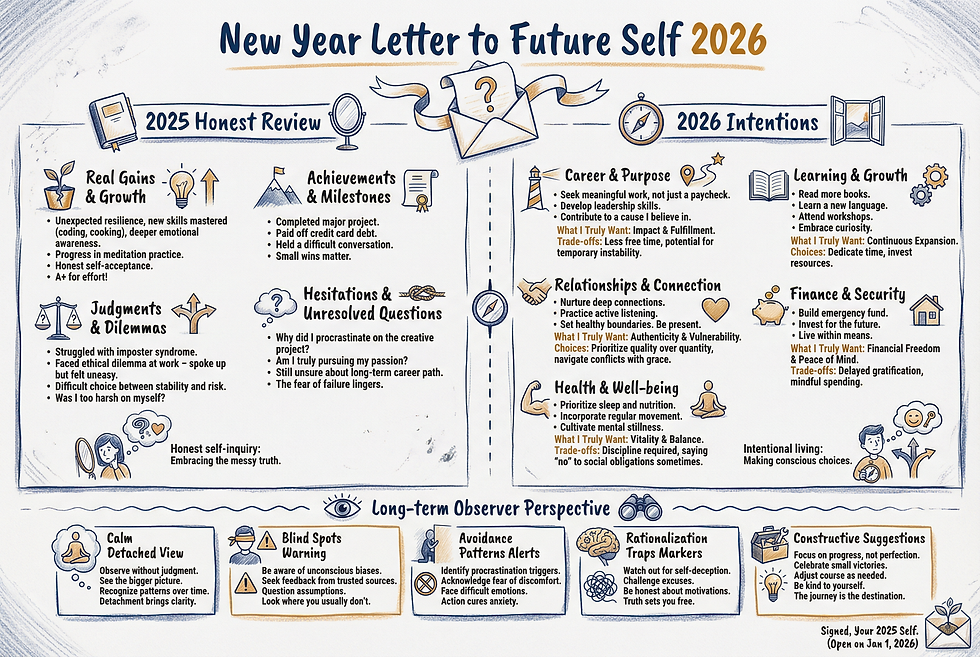
1) Future-Self Letter (Annual Review) — evidence-based, calm, and unsentimental Prompt:
Every New Year’s Day, I write an email to my future self for the coming year. In this letter, I’m 100% honest with myself—I record the real gains, growth, achievements, judgments, thoughts, dilemmas, hesitations, and unresolved questions from the past year. At the same time, I think carefully about what I truly want in the next year across the major important dimensions of my life, as well as the choices and trade-offs I may have to face.
I also hope you can take the perspective of a long-term observer and offer a calm, detached view. Don’t encourage me—instead, genuinely point out what I’m likely to overlook, avoid, or rationalize to myself, and offer constructive suggestions and methods for 2026. I want you to describe and evaluate things objectively. Help me recall as many facts and details as possible.

2) CEO Lens — One-line strategy + three tables
Prompt: You are my “Annual Review CEO Advisor.” Using all retrieved notes (meeting notes, project logs, OKRs, customer comms, weekly reviews, retros), produce an annual summary with:
A one-sentence strategic narrative of my year.
Three tables: Outcomes, Investments, Trade-offs;
Every claim must include a citation with date and source note. Use: (CITATION: note_title, note_id, date);
End with 3 prioritized recommendations for next year, each with rationale and risks, also cited.Output structure: Executive summary → 3 tables → Evidence index → Next-year priorities.
3) Data-journalism Style — “Year in Review” report
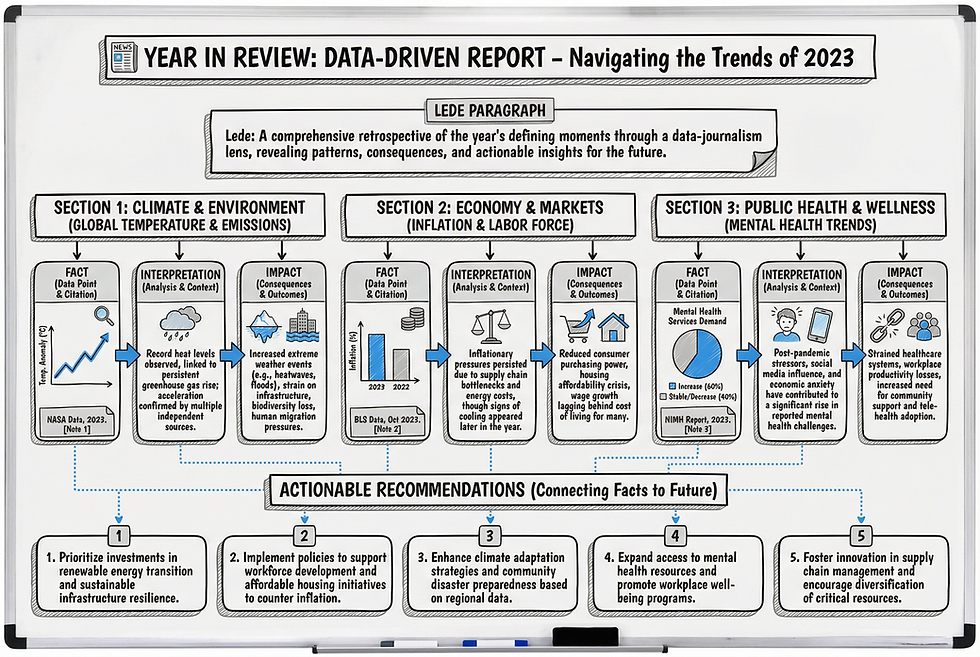
Prompt: Write my year as a data-driven news report based on retrieved notes. Requirements:
Headline + lede + 3 sections with subheadings;
Each section uses Fact → Interpretation → Impact;
Include at least 8 verifiable facts, each with date + citation: (CITATION: …);
Neutral tone (no hype, no motivational clichés);
End with 5 actionable recommendations, each explicitly tied to cited facts.

4) GTD / Productivity Audit — time and attention review
Prompt: Act as a time-and-attention auditor. From retrieved notes, produce a “Work System Retrospective”:
Summarize my major inputs (meetings, chat, customer requests, internal asks) and outputs (docs, deals, deliverables);
Identify 5 biggest time sinks / repeat work patterns with typical scenarios and citations;
Extract 5 workflows that worked best (trigger → steps → output) with citations;
Propose a minimum-change plan (only 3 changes) with expected benefit + side effects, grounded in evidence.Cite every diagnosis: (CITATION: …).

5) Sales Director Lens — pipeline + account strategy (ideal for sales)
Prompt: You are a B2B Sales Director. Using all customer-related notes (call notes, emails summaries, proposals, pipeline updates, win/loss reviews), produce my annual sales retrospective:
Cluster by customer / industry / product line and summarize win patterns and loss patterns (each pattern must have citations);
Extract my 10 most effective talk tracks / questions with the situation where used + citations;
Diagnose pipeline friction by stage (lead → discovery → solution → negotiation → close → renewal) with evidence;
Propose 3 growth hypotheses for next year + validation plan (what evidence to collect, how to track), all linked to current citations.

6) Competency Model — evidence-based radar
Prompt: Build an evidence-based competency review from retrieved notes:
Propose an 8-dimension competency framework (define each dimension clearly);
For each dimension, provide ≥3 evidence items with date + citations;
Score each dimension 0–5 and explain why (cite evidence);
Recommend 3 highest-ROI improvement areas with practice methods and observable metrics, grounded in cited gaps.Use (CITATION: …) on every evidence bullet.

7) “Failure Museum” — antifragile retrospective
Prompt: Focus only on failures, deviations, risk exposure. From retrieved notes:
List 10 failure/near-miss/rework events, each with: context, trigger, my assumption at the time, outcome, cost, and citations;
Deep-dive the top 3 using 5 Whys (or fishbone), citing each causal step;
Produce 7 early warning signals for future similar issues, each linked to evidence;
Output an antifragile checklist: do more / do less / add backups, with citations.

8) Portfolio / Casebook — STAR or CAR stories
Prompt: Turn my year into a professional portfolio based on retrieved notes:
Select 6–10 representative cases that best demonstrate my value;
Write each case in STAR (Situation, Task, Action, Result) or CAR (Context, Action, Result);
Include citations per case: [Sources: (CITATION: …), (CITATION: …)];
Provide a sanitized external version (remove sensitive info);
End with a 200–300 word performance-review / promotion / interview-ready summary, supported by citations.

9) Theme Map — knowledge graph + compounding bets
Prompt: Extract themes and connections from retrieved notes to create my annual “Theme Map”:
List 10–15 high-frequency themes, define each, and cite representative notes;
Identify key relationships between themes (e.g., customer insight → product feedback → proposal iteration), citing examples;
Highlight 3 compounding themes (the more I build, the more value accrues) + next-year strategy to deepen them;
Output: Theme table + relationship map + compounding strategy, with citations throughout.

10) Coaching Questions — guided self-dialogue with evidence
Prompt: Be my annual review coach. Based on retrieved notes, ask me 20 high-quality questions. For each question include:
The “signals” you observed in my notes (with citations);
Why the question matters;
Two possible answering directions (to help me think, not to conclude for me).Cover: goals, values, collaboration, growth, health/energy, compensation/ROI, boundaries/trade-offs.
If you’re reading these prompts and thinking, “This looks amazing—but I haven’t captured enough notes this year, so the summary might end up vague,” you’re not alone. These workflows get dramatically better with more real context to retrieve from your own records. The more notes you’ve accumulated, the more specific and evidence‑backed the output can be.
If you want a chatbot that helps you build a context hub over time, and then reliably recall it when you need it, try remio.


