Testing NVIDIA Nitrogen: The Reality of Vision-to-Action AI Gaming

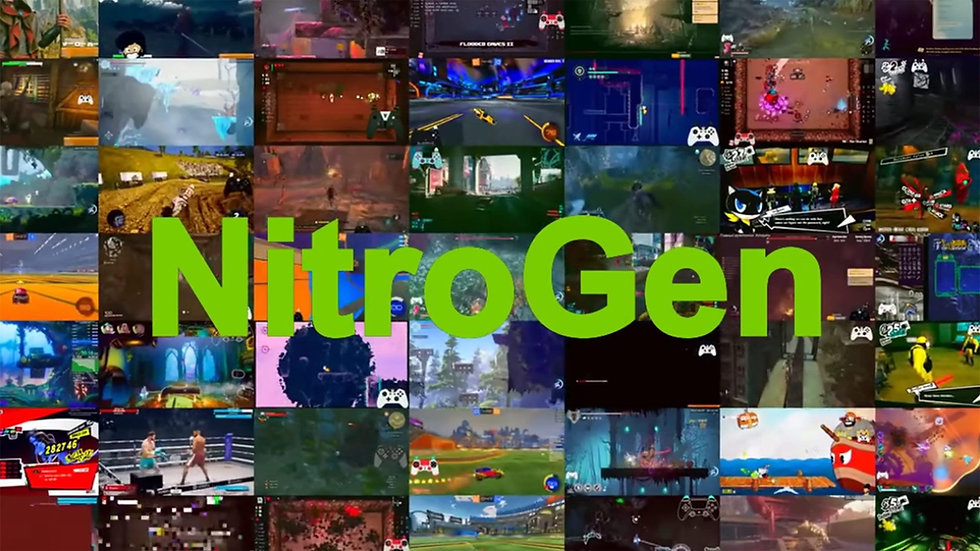
The release of NVIDIA Nitrogen marks a distinct pivot in how we approach machine intelligence in virtual environments. For years, game-playing AI relied heavily on reinforcement learning—painstakingly defining reward functions or hooking directly into game APIs to read state data. NVIDIA Nitrogen attempts something radically different: it looks at the screen.
By processing raw video frames and translating them directly into controller inputs, this vision-to-action AI model treats games the way humans do. It doesn't see code; it sees pixels. While the promise of a general-purpose agent that can play anything from Rocket League to Super Mario is alluring, early community tests and technical documentation reveal a gap between the theoretical architecture and the current reality of running this on your home PC.
Real-World Performance: Running NVIDIA Nitrogen on Consumer Hardware

Before dissecting the architecture, we need to address how this model actually feels to use. This isn't a theoretical paper; it’s a 1.97GB weight file you can download and run. However, early adopters testing NVIDIA Nitrogen have hit a wall that often plagues first-generation foundational models: inference latency.
Latency Challenges in Vision-to-Action AI
The core proposition of Vision-to-Action AI is that it reacts to what it sees. But reaction time matters. In testing scenarios involving older but capable hardware, such as the RTX 2080 Super, the performance overhead is massive.
One documented test case highlighted a severe bottleneck: over a one-hour runtime duration, the model only generated about five minutes of effective gameplay footage. The ratio of processing time to action execution is currently skewed heavily against real-time play for average consumers. When you are asking a model to ingest high-resolution RGB frames, process them through a vision transformer, and generate discrete gamepad tokens via diffusion, the computational cost accumulates instantly.
This creates a "lagging" sensation that renders fast-paced action games unplayable in real-time on anything less than top-tier enterprise hardware. The model captures the frame, thinks, and outputs the button press—but by the time the button press registers, the game state has already changed.
Hardware Bottlenecks and Optimization Needs
The NVIDIA Nitrogen documentation is explicit about the need for CUDA acceleration, but the reality of deployment goes further. The model’s reliance on the Diffusion Transformer (DiT) for action generation is computationally heavy compared to simpler policy networks used in older AI approaches.
Currently, NVIDIA Nitrogen functions less like a player and more like a turn-based strategist forced to play an action game. For developers looking to integrate this vision-to-action AI, the immediate hurdle isn't the model's intelligence—it's the optimization of the inference pipeline. Until quantization or distillation techniques reduce the overhead, this remains a tool for H100 clusters rather than gaming laptops.
How NVIDIA Nitrogen Redefines Vision-to-Action AI

Understanding why the model demands such high resources requires looking at its architecture. NVIDIA Nitrogen isn't just "watching" video; it is synthesizing understanding and action simultaneously through a two-stage process.
The SigLip2 and DiT Architecture
The model moves away from standard Convolutional Neural Networks (CNNs). Instead, it employs SigLip2, a sophisticated vision encoder. This component breaks down the RGB input frame into digestible embeddings—essentially translating visual data into a mathematical language the system understands.
Once the visual context is established, it is passed to the DiT (Diffusion Transformer). This is where NVIDIA Nitrogen diverges from traditional actors. Instead of simply classifying the "best next move," it generates the action sequence using diffusion processes, similar to how image generators create pictures from noise. The result is a more nuanced understanding of movement, allowing for continuous values in joystick inputs rather than just binary up/down/left/right commands.
From Pixels to Gamepad Tokens
The output specification of NVIDIA Nitrogen is surprisingly lean given the complexity of its input. It produces a tensor shape of 21x16. This translates to:
Two continuous vectors representing the analog sticks (aiming and movement).
Seventeen binary values representing the buttons (triggers, bumpers, face buttons, D-pad).
This design choice confirms that Vision-to-Action AI is being built with a "universal interface" mindset. By standardizing the output to a generic controller schema, the model doesn't need to know the specific control bindings of a new game. It just needs to associate a visual cue (a jump ramp) with a specific controller output (pressing 'A'), mimicking the human learning process of figuring out controls by trial and error or imitation.
Beyond Gaming: Applications for Vision-to-Action AI

While playing Minecraft or racing games is the visual demo, the utility of NVIDIA Nitrogen extends into development pipelines and accessibility tech. The capability to interact with software solely through its visual interface opens doors that API-based bots cannot pass.
NVIDIA Nitrogen in Automated Game QA Testing
The most immediate commercial application for NVIDIA Nitrogen is in Quality Assurance (QA). Modern open-world games and live-service titles require thousands of hours of playtesting to find bugs. Scripted bots often break when the UI changes or when a specific pixel coordinate shifts.
A vision-to-action AI doesn't rely on hard-coded coordinates. It can effectively "roam" a game world, navigating terrain and interacting with menus even if the underlying code has changed, provided the visual logic remains consistent. This allows studios to deploy fleets of AI agents to stress-test servers, run wall-collision checks in vast maps, or verify that NPC interactions function correctly without requiring human testers to run into walls for eight hours a day.
Accessibility and the "Second Player" Concept
Community discussions have highlighted a poignant demand for this technology: the "Couch Co-op" partner. Many games feature cooperative modes that are inaccessible to solo players. A generic agent like NVIDIA Nitrogen could fill the role of Player 2, managing the mechanics of a teammate without needing specific programming for that title.
Furthermore, this aligns with broader goals in accessible gaming. For players with physical disabilities who cannot operate a standard controller, a vision-to-action AI could act as a bridge—interpreting simplified inputs from the user and executing complex controller maneuvers in the game, effectively functioning as an intelligent "aim assist" or navigation copilot that understands the context of the screen.
Limitations & Future: Where Vision-to-Action AI Stumbles

Despite the advanced architecture, NVIDIA Nitrogen is not a universal solver. Its training data—video files—imposes specific behavioral limitations that distinguish it from logic-based AI.
The Strategy Game Problem
The model excels at twitch reactions and continuous navigation—tasks that map well to analog stick movements and visual flow. It struggles significantly with long-horizon planning. Users attempting to apply NVIDIA Nitrogen to strategy games (RTS) or titles like Civilization will find it lacking.
These genres require mouse precision and abstract planning (e.g., "I need to build a farm now to have food in 20 minutes"). Because the model operates on immediate visual feedback and imitation, it lacks the internal logic state to plan usually required for complex strategy. It mimics the appearance of playing, which works for driving a car but fails when managing an economy. If the required action isn't visually prompted by the immediate frame, the model drifts.
The Path to Self-Correcting Agents
The holy grail for NVIDIA Nitrogen and similar vision-to-action AI models is the "Agentic Mode." Current iterations are open-loop in many implementations—they see and act, but they don't necessarily reflect on why an action failed.
Future developments need to close this loop, allowing the AI to recognize a "Game Over" screen or a stuck character model as negative feedback. Enabling the model to write its own correction logic—identifying that walking into a wall produces no visual flow change, and therefore altering the input—is the next step. Once NVIDIA Nitrogen can self-diagnose failure rather than just imitating success, the latency issues will become a secondary concern to its sheer adaptability.
Adaptive FAQ
What hardware do I need to run NVIDIA Nitrogen locally?
To run the model effectively, you need an NVIDIA GPU with significant VRAM. While it can technically load on cards like the RTX 2080 Super, practical usage requires newer architecture (RTX 30/40 series) to handle the heavy inference load of the DiT and SigLip2 components without debilitating latency.
Does NVIDIA Nitrogen require the game's source code to work?
No. The model is a "vision-to-action" system, meaning it only needs the video output (RGB frames) from the game. It interacts with the software exactly like a human does, by viewing the screen and sending virtual controller signals, making it compatible with closed-source games.
Why is the model slow or laggy during gameplay?
The latency comes from the two-step processing pipeline: analyzing the image with the vision transformer and generating actions via diffusion. This calculation takes time (milliseconds to seconds depending on hardware), creating a delay between what happens on screen and when the AI reacts.
Can NVIDIA Nitrogen play mouse and keyboard games?
It is optimized for gamepad inputs (joysticks and buttons). While you could technically map outputs to keyboard keys, the model is trained on movements inherent to controllers, such as continuous analog steering. It performs poorly in games requiring high-precision mouse clicking, like RTS or MOBA titles.
Is this model using Reinforcement Learning (RL)?
No, NVIDIA Nitrogen uses Imitation Learning based on video data. Unlike RL, which learns by maximizing a reward score (like points), Nitrogen learns by watching vast amounts of human gameplay footage and predicting the correct action to match the visual context.


